
Why Every Business Needs SOC Compliance: A Leader’s Guide

TL;DR:
- SOC 2 compliance accelerates business growth by streamlining vendor assessments and strengthening governance. It requires independent testing of controls across security, availability, processing integrity, confidentiality, and privacy. Achieving continuous SOC 2 Type II certification builds trust, reduces operational risk, and supports enterprise sales and regulatory requirements.
SOC 2 compliance is a direct business accelerator: it replaces lengthy security questionnaires with a single independently attested report, gives boards audit-ready governance evidence, and reduces operational risk through tested controls across the Trust Services Criteria. For any U.S. organization handling customer data or selling into enterprise accounts, the case for SOC 2 is no longer theoretical.
Why SOC compliance matters right now:
- Sales acceleration. A current SOC 2 report replaces dozens of security questionnaire items, shortening procurement cycles and removing a common deal-blocker.
- Governance evidence. Boards and executive teams increasingly treat SOC reports as vendor risk oversight tools, not just technical audit artifacts.
- Operational risk reduction. Documented, tested controls across security, availability, processing integrity, confidentiality, and privacy identify vulnerabilities before they become breaches or lawsuits.
Table of Contents
- What does SOC 2 actually assess?
- How does SOC 2 benefit your business beyond just compliance?
- Which businesses should pursue SOC 2 and when?
- Type I vs. Type II: which report do customers actually ask for?
- How do you achieve SOC 2 compliance? A practical roadmap
- What does SOC 2 compliance typically cost?
- What do independent auditors actually examine?
- Common misconceptions that put organizations at risk
- What should executives do in the first 90 days?
- Key Takeaways
- SOC 2 is a governance decision, not just a security project
- Supraits helps you get SOC 2 ready and keep it that way
- Useful sources
- FAQ
What does SOC 2 actually assess?
SOC 2 is an attestation framework developed by the American Institute of Certified Public Accountants (AICPA). An independent CPA firm examines whether a service organization’s controls meet the Trust Services Criteria, then issues a formal opinion. Unlike regulatory mandates such as HIPAA or GDPR, SOC 2 is market-driven, not legally required. Enterprise buyers effectively make it mandatory by demanding it before signing contracts.
The five Trust Services Criteria are:
- Security — protection of systems against unauthorized access and disclosure
- Availability — systems operate and are available as agreed with customers
- Processing integrity — system processing is complete, accurate, and authorized
- Confidentiality — information designated as confidential is protected appropriately
- Privacy — personal information is collected, used, retained, and disclosed per policy
Only Security is required for every SOC 2 engagement. The remaining four criteria are selected based on the services provided and customer expectations.
How does SOC 2 benefit your business beyond just compliance?
The importance of SOC compliance reaches well past a checkbox on a vendor questionnaire. Here are the concrete outcomes organizations see:
- Faster sales cycles. A current SOC 2 Type II report is widely accepted by enterprise buyers and often replaces bespoke vendor security audits entirely.
- Access to regulated markets. Healthcare, financial services, and government supply chains frequently require independent assurance before onboarding a vendor.
- Investor and partner confidence. Demonstrating security compliance with a framework like SOC 2 builds a foundation of trust that supports capital raises and strategic partnerships.
- Stronger internal security posture. The readiness process forces documentation, control ownership, and remediation tracking, making organizations materially more secure after the work is done.
Procurement impact: According to Vanta, the average cost of a data breach reached $4.45 million, covering employee remediation costs, fines, penalties, and lost revenue as customers switch vendors. SOC 2 controls directly reduce the likelihood of reaching that threshold.
For teams focused on scaling enterprise sales, a SOC 2 report removes one of the most consistent friction points in late-stage procurement.

Which businesses should pursue SOC 2 and when?
SOC 2 is particularly common among SaaS providers, managed IT service organizations, cloud platforms, and data analytics firms. If any of the following apply, the time to start is now:
- Your organization stores, processes, or transmits customer data on behalf of clients.
- Enterprise buyers or government agencies are in your sales pipeline.
- An RFP has already asked for a SOC 2 report or equivalent attestation.
- A contract stalled at the security review stage in the last 12 months.
- You are entering healthcare, financial services, or federal supply chains.
- Your vendor risk team is receiving SOC reports from your own suppliers and expects reciprocity.
- You plan to raise institutional capital or pursue M&A activity within the next 18 months.
The market signals the urgency. The bigger the customer, the more likely they require a SOC 2 report before signing.
Type I vs. Type II: which report do customers actually ask for?
| Dimension | SOC 2 Type I | SOC 2 Type II |
|---|---|---|
| What it proves | Controls are designed appropriately at a point in time | Controls operated effectively over an observation period |
| Observation period | None (single date) | Typically several months to a year |
| Enterprise acceptance | Limited; often treated as a stepping stone | Widely accepted; preferred for enterprise deals |
| Audit duration | Shorter (weeks) | Longer (months of evidence collection) |
| Governance value | Low to moderate | High; supports board-level vendor oversight |
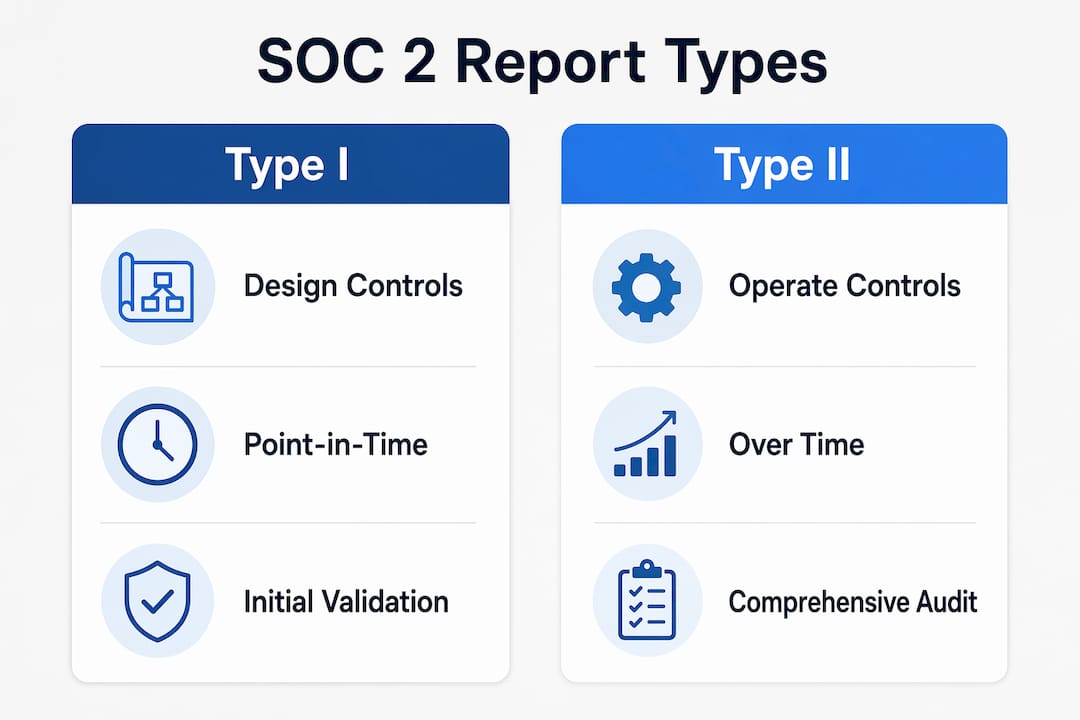
SOC 2 Type II reports are decisive in enterprise procurement because they demonstrate that controls operated effectively over time, which short-circuits many buyer audit requirements. A Type I can serve as an interim milestone for organizations that need to show progress quickly, but enterprise IT teams know the difference and will ask for Type II.
How do you achieve SOC 2 compliance? A practical roadmap
Phase timeline (typical ranges, not guarantees):
| Phase | Typical Duration |
|---|---|
| Readiness assessment and gap analysis | 4–12 weeks |
| Control remediation and documentation | 6 weeks |
| Evidence collection (Type II observation period) | Several months to a year |
| Auditor fieldwork and report issuance | 4 weeks |
The step-by-step path:
- Readiness assessment. Identify gaps between current controls and the Trust Services Criteria. Assign an executive sponsor and a compliance owner.
- Gap remediation. Fix policy gaps, implement missing controls, and document ownership for each control domain.
- Evidence collection. Gather access logs, change approval records, incident response documentation, and access review outputs throughout the observation period.
- Auditor selection. Engage a licensed CPA firm with SOC 2 experience. The AICPA sets attestation standards; only qualified CPA firms can issue the report.
- Audit and report. The auditor tests controls, reviews evidence, and issues an opinion. Exceptions are documented with management responses.
- Re-attestation planning. Most organizations complete a SOC audit annually to maintain current assurance for customers and stakeholders.
Common evidence types auditors expect:
- System access logs and user provisioning/deprovisioning records
- Change management approvals and deployment records
- Incident response tickets and escalation logs
- Encryption key management documentation
- Vendor and subservice organization review records
What does SOC 2 compliance typically cost?
Cost varies by organization size, control maturity, and whether automation tooling is used. The table below reflects typical U.S. market ranges and should be treated as planning estimates.
| Cost Driver | Typical Range |
|---|---|
| Readiness consulting | $15,000 |
| Audit fees (CPA firm) | $20,000 |
| Compliance automation tooling | $10,000/year |
| Internal staff time (FTEs) | Part-time to full-time effort over several months |
Three ways to reduce cost without cutting corners: start with a phased scope (Security criterion only), prioritize control remediation by risk severity, and use evidence automation tools to reduce manual collection burden.
Pro Tip: Organizations with limited security headcount often achieve the most cost-efficient path by engaging a managed compliance partner who combines readiness consulting, evidence automation, and auditor coordination under one engagement rather than sourcing each separately.
What do independent auditors actually examine?
Auditors operating under AICPA attestation standards evaluate whether controls are designed appropriately and, for Type II, whether they operated consistently throughout the observation period. Their opinion is not a certification of perfect security; it is a professional attestation that tested controls functioned as described.
Specific evidence auditors commonly review includes access provisioning and deprovisioning logs, change approval records, incident response documentation, and encryption key governance artifacts. They also evaluate management responses to any exceptions identified, looking for accountability and a credible remediation plan.
“SOC reports are a foundational vendor management instrument for organizations evaluating service providers that support critical systems, financial operations and security expectations. For boards and senior executives, the value lies in confirming that essential controls exist, that exceptions are formally documented with accountable ownership, and that vendor-managed environments maintain structured governance.” — Withum
An independent CPA firm opinion carries governance weight precisely because it cannot be self-issued. Procurement teams and boards treat it as decision-ready evidence, not a vendor’s own claim.
Common misconceptions that put organizations at risk
Myth 1: SOC 2 is a legal requirement. It is not. SOC 2 is market-driven; there are no regulatory penalties for lacking a report. The consequence is commercial: lost contracts and excluded procurement processes.
Myth 2: A SOC 2 report guarantees security. An attestation confirms that tested controls operated as described during the observation period. It does not mean the organization is breach-proof.
Myth 3: Type I is equivalent to Type II. Enterprise buyers know the difference. A Type I report demonstrates point-in-time design; it does not prove sustained operational effectiveness.
The deeper risk is treating SOC 2 as a one-time checkbox. Organizations that complete an audit and then let controls drift face recurring exceptions, audit failures in subsequent years, and the reputational damage of a report that shows deteriorating control performance.
“Organizations that treat SOC 2 as an integrated governance process, not a one-off audit, gain the most long-term business value. Continuous monitoring and re-attestation keep controls effective.” — Compyl
SOC 2 also overlaps with regulatory frameworks including HIPAA, PCI DSS, and GDPR, creating auditable records that carry weight in regulatory or legal contexts. A checkbox approach forfeits that downstream value.
What should executives do in the first 90 days?
Week 1:
- Commission a formal readiness assessment with a defined scope.
- Designate an executive sponsor with budget authority.
- Assign a compliance owner responsible for evidence collection and control tracking.
- Pull baseline samples of current access logs, incident records, and policy documentation.
Days 30–60:
- Complete gap analysis and prioritize remediation by risk severity.
- Assign control owners across IT, security, and operations.
- Select evidence collection tooling or a managed compliance partner.
- Interview two or three CPA firms to select your auditor early.
Days 60–90 and ongoing:
- Begin the formal observation period for Type II.
- Establish a monthly control monitoring cadence.
- Integrate SOC metrics into quarterly board reporting.
- Schedule re-attestation planning 90 days before the current report expires.
For organizations pairing compliance with a broader SaaS sales strategy, having a SOC 2 report in progress is itself a credible signal to enterprise prospects during the sales cycle.
Key Takeaways
SOC 2 compliance is the most direct way for U.S. service organizations to reduce procurement friction, demonstrate governance maturity, and lower the operational risk of a data breach.
| Point | Details |
|---|---|
| Sales acceleration | A SOC 2 Type II report replaces lengthy security questionnaires and removes a common enterprise deal-blocker. |
| Governance evidence | Boards and vendor risk teams treat SOC reports as independently validated inputs for oversight decisions. |
| Type II is the standard | Enterprise buyers prefer Type II because it proves controls operated effectively over a 6–12 month period. |
| Compliance is ongoing | Organizations that monitor controls continuously and re-attest annually gain the most long-term business value. |
| Supraits delivers it | Supraits holds SOC 2 Type II certification and provides managed readiness, remediation, and compliance services for mid-size to large organizations. |
SOC 2 is a governance decision, not just a security project
Most organizations approach SOC 2 as an IT initiative. That framing underestimates what the report actually delivers. A SOC 2 Type II attestation is board-level evidence: it tells your customers, your investors, and your regulators that your internal controls were independently tested and held up over time. That is a governance statement, not a technical one.
What gets underestimated is the commercial leverage. Organizations that complete SOC 2 before a major enterprise deal enters the security review stage close faster and lose fewer late-stage opportunities to compliance friction. The organizations that wait until a contract is stalled pay the same cost in time and money, but without the competitive advantage.
The process also tends to surface control gaps that internal teams had normalized. Readiness work forces documentation and ownership in ways that routine operations rarely do. That operational discipline persists after the audit, which is why the organizations that treat SOC 2 as a governance program rather than a project consistently outperform those that treat it as a one-time exercise.
Supraits helps you get SOC 2 ready and keep it that way
Supraits holds SOC 2 Type II certification and brings over 25 years of enterprise IT experience to managed compliance engagements. For organizations ready to pursue SOC 2, Supraits provides readiness assessments, control remediation, evidence automation, and ongoing governance support, covering the full path from gap analysis to auditor coordination.
With a team of 650+ specialists across cybersecurity, cloud security, and managed IT, Supraits is built for mid-size to large organizations in healthcare, research, transportation, and any sector where enterprise-grade compliance is a commercial requirement.
Pro Tip: Include SOC report readiness as a defined deliverable in your managed IT onboarding contract. It sets a clear governance milestone and signals to enterprise prospects that compliance is built into your operations from day one.
Contact Supraits to schedule a readiness assessment and get a clear picture of your path to SOC 2 certification. Visit supraits.com to start the conversation.
Useful sources
- AICPA: SOC 2 Audit Report — Primary AICPA guidance on what SOC 2 attests to and the Trust Services Criteria framework.
- Withum: SOC Reports Explained for Boards and Executives — Practical executive-level interpretation of SOC reports for governance and vendor oversight.
- Vanta: Why SOC 2 Is Important — Business-focused overview of SOC 2 benefits, including breach cost context and revenue impact.
- CertPro: Why Is SOC 2 Important? — Covers market acceptance, regulatory alignment, and procurement expectations.
- Drata: SOC 2 Type 1 vs. Type 2 — Clear comparison of report types and why Type II is preferred for enterprise deals.
- Compyl: Why Is SOC 2 Compliance Important? — Focuses on continuous monitoring and the long-term governance value of ongoing compliance.
- StrikeGraph: Understanding and Accelerating Security Questionnaires — Details how SOC 2 replaces repetitive security questionnaires and shortens sales cycles.
FAQ
What is SOC 2 compliance and why does a business need it?
SOC 2 is an AICPA attestation framework that independently verifies a service organization’s controls across security, availability, processing integrity, confidentiality, and privacy. Businesses need it to meet enterprise procurement requirements, reduce data breach risk, and demonstrate governance maturity to customers and boards.
Is SOC 2 legally required in the United States?
SOC 2 is not legally mandated; there are no regulatory penalties for lacking a report. However, enterprise buyers, particularly in healthcare, financial services, and technology sectors, routinely require a current SOC 2 report before signing vendor contracts.
What is the difference between SOC 2 Type I and Type II?
Type I confirms that controls are designed appropriately at a single point in time. Type II confirms that those controls operated effectively over an observation period of typically 6–12 months, which is why enterprise buyers strongly prefer it.
How long does it take to get SOC 2 certified?
A full SOC 2 Type II engagement typically takes many months from readiness assessment through report issuance, including an extended observation period. A Type I report can be completed in a shorter timeframe for organizations that need an interim milestone.
How can Supraits help with SOC 2 readiness?
Supraits holds SOC 2 Type II certification and provides end-to-end managed compliance services, including readiness assessments, control remediation, evidence automation, and auditor coordination, for mid-size to large organizations across healthcare, research, transportation, and related sectors.
Recommended


