
What Is Digital Infrastructure: A 2026 Guide for IT Leaders

TL;DR:
- Digital infrastructure comprises an integrated ecosystem of hardware, software, energy, and cybersecurity systems essential for data processing and protection. Investing in its resilience and strategic design enables organizations to enhance operational efficiency, scalability, and long-term competitiveness. Effective management involves mapping dependencies, planning for stress resilience, and aligning infrastructure with business goals in a rapidly evolving technology landscape.
Digital infrastructure is one of those terms that gets thrown around confidently but rarely defined with precision. Most organizations treat it as a synonym for their server room or cloud subscription, which leads to strategic gaps that surface at the worst possible moments. Understanding what digital infrastructure actually encompasses, how its components interact, and why that interaction matters is the foundation for every sound technology decision your organization will make in 2026 and beyond.
Table of Contents
- Key Takeaways
- What is digital infrastructure: definition and core components
- Why digital infrastructure matters for organizations
- Types and examples of digital infrastructure
- Building resilient digital infrastructure
- Practical applications for IT leaders in 2026
- My perspective on digital infrastructure as a strategic asset
- How Supraits helps you build infrastructure that holds
- FAQ
Key Takeaways
| Point | Details |
|---|---|
| Beyond basic IT | Digital infrastructure is an integrated ecosystem, not just servers and networks, spanning hardware, software, energy, and cybersecurity. |
| Strategic asset class | Organizations that treat digital infrastructure as a core strategic investment gain competitive resilience and long-term operational stability. |
| Resilience requires design | True resilience means planning survivability paths independent of failing systems, not simply adding redundancy. |
| Types vary by context | Physical, software-defined, and advanced technology layers each serve distinct roles that must be coordinated. |
| Leadership action matters | IT decision-makers must align infrastructure planning with organizational strategy, compliance goals, and emerging technology demands. |
What is digital infrastructure: definition and core components
Digital infrastructure in 2026 is best defined as an integrated ecosystem of hardware, software, networks, energy systems, and managed services that collectively enables an organization to process, store, transmit, and secure data. That definition is deliberately broad, because the reality is broad. It is not just your data center or your cloud contract. It includes the power and cooling systems keeping those assets online, the cybersecurity frameworks governing access, and the multi-cloud environments distributing workloads across providers.
Traditional IT infrastructure focused primarily on computing hardware and basic network connectivity. Digital infrastructure is the evolution of that thinking. It accounts for the fact that modern workloads, including AI inference, edge computing, and real-time analytics, demand a tightly coordinated foundation where every layer depends on the others.
The core digital infrastructure components include:
- Data centers and colocation facilities: The physical layer housing servers, storage arrays, and networking equipment.
- Cloud platforms: Public, private, and hybrid cloud environments providing on-demand compute and storage capacity.
- Network fabric: Fiber optic lines, wireless networks, SD-WAN, and internet exchange points connecting systems internally and externally.
- Cybersecurity frameworks: Identity and access management, endpoint detection, encryption, and compliance controls protecting data integrity.
- Energy and cooling systems: Uninterruptible power supplies, backup generators, and precision cooling that sustain continuous operations.
- AI and edge compute nodes: Distributed processing resources that reduce latency for time-sensitive workloads like autonomous systems and industrial IoT.
Pro Tip: When auditing your organization’s digital infrastructure, map energy and cooling dependencies alongside your network and compute assets. Power instability is one of the most common but least documented sources of outage risk.
Why digital infrastructure matters for organizations
The importance of digital infrastructure goes well beyond keeping the lights on. It is the operational backbone that determines how quickly your organization can adapt, scale, and recover.
Research using city-level data from 2011 to 2023 demonstrates that digital infrastructure construction directly accelerates enterprise productivity by enabling smart transformation and innovation, with measurable effects concentrated in growth-stage organizations. That finding has a clear implication: infrastructure investment is not overhead. It is a productivity multiplier.
The benefits of digital infrastructure for businesses span several dimensions:
- Operational efficiency: Automated provisioning, centralized monitoring, and orchestrated workloads reduce manual labor and error rates across IT operations.
- Scalability: Cloud-native architectures allow organizations to expand capacity on demand without the capital delays of physical procurement cycles.
- Innovation speed: When foundational systems are stable and well-documented, development teams spend less time firefighting and more time building.
- Economic resilience: During disruptions, organizations with mature digital infrastructure restore operations faster and lose less revenue than those relying on ad-hoc recovery procedures.
Digital resilience is economic resilience. Organizations that design their infrastructure for stress rather than only expected operating conditions are the ones that maintain continuity when correlated failures hit across systems simultaneously.
This connection between infrastructure maturity and business continuity is why digital infrastructure is increasingly viewed as a strategic asset class, one that provides stable cash flows, inflation hedging properties, and low correlation with public market volatility.
Types and examples of digital infrastructure
Understanding the types of digital infrastructure helps IT leaders make targeted investment decisions rather than treating every layer as interchangeable.
The table below outlines the primary categories, their characteristics, and representative examples:
| Type | Key characteristics | Examples |
|---|---|---|
| Physical assets | Tangible hardware and facilities requiring capital investment and physical maintenance | Data centers, fiber optic cables, server farms, colocation facilities |
| Software-defined systems | Virtualized and programmable layers managed through software control planes | Cloud platforms (AWS, Azure, GCP), SD-WAN, containerized environments |
| Cybersecurity infrastructure | Protective frameworks governing identity, access, data integrity, and threat response | Zero-trust architectures, SIEM platforms, endpoint detection and response tools |
| Energy and support systems | Physical systems sustaining uptime and environmental conditions | UPS systems, backup generators, precision cooling, power distribution units |
| Advanced technology layers | Emerging compute and network models enabling AI, automation, and low-latency processing | Edge computing nodes, AI inference clusters, decentralized P2P networks |
Real-world examples of digital infrastructure span every sector. In healthcare, electronic health record systems depend on compliant cloud storage, encrypted networks, and role-based access controls working in concert. In finance, high-frequency trading platforms require sub-millisecond network latency backed by colocated servers and redundant fiber paths. Smart cities integrate sensor networks, edge compute nodes, and centralized data platforms to manage traffic, utilities, and public safety in real time.

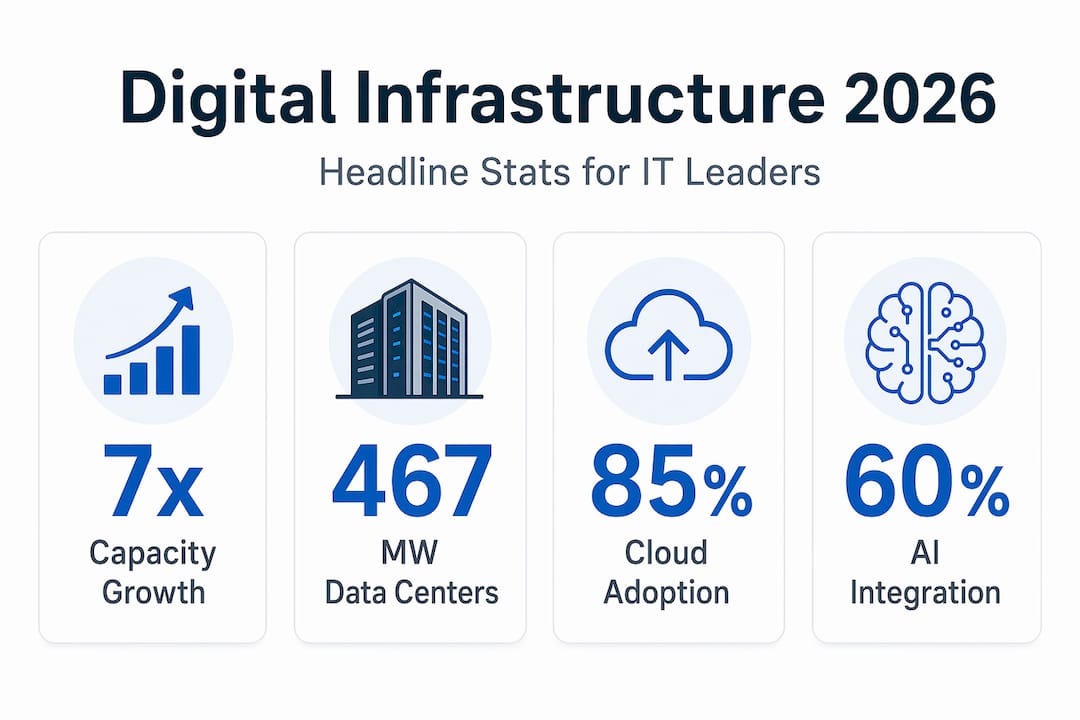
The scale of investment in this space is substantial. Saudi Arabia’s data center capacity grew from 68 MW to 467 MW between 2021 and early 2026, a 587% increase driven by AI workload demand and cloud adoption. That figure illustrates how the convergence of AI and cloud computing is reshaping infrastructure requirements at a national level. For emerging markets, prioritizing investments in fiber, power, and biometric ID infrastructure has proven more impactful for fintech growth than regulatory frameworks alone, a lesson that applies equally to enterprise IT environments where concrete capability matters more than documented policy.
Building resilient digital infrastructure
Resilience is where most digital infrastructure strategies fall short. Organizations invest in redundancy and assume that doubles their protection. It does not.
Outages frequently stem from hidden dependencies shared across systems, including shared fiber corridors, common power grids, and centralized identity services, rather than isolated equipment failures. When these shared layers fail, redundant systems that depend on the same fiber or the same identity provider fail together. That is the coupling problem, and it is far more dangerous than a single server going offline.
Building genuinely resilient infrastructure requires moving from a stability assumption model to a stress design model. Here are the core steps:
- Map all dependency layers. Document not just your primary systems but every shared resource those systems rely on, including physical paths, power feeds, and third-party service dependencies.
- Identify hidden single points of failure. Look for shared fiber routes, common DNS resolvers, and centralized authentication providers that span multiple critical systems.
- Design survivability paths. Plan recovery paths independent of the systems most likely to fail, including out-of-band identity and management capabilities accessible when primary systems are degraded.
- Test under correlated failure scenarios. Simulate simultaneous failures in network, power, and identity layers rather than testing each component in isolation.
- Address cross-border dependencies. Mapping supercritical interconnections like cross-border digital identity systems is vital for strategic autonomy. Organizations that fail to do this expose themselves to operational dependency risks during geopolitical disruptions.
Pro Tip: Coordinate continuity planning with all major stakeholders including cloud providers, ISPs, and facilities managers before a crisis, not during one. Most organizations discover their recovery plans have critical gaps only when those plans are being executed under pressure.
Practical applications for IT leaders in 2026
Translating digital infrastructure concepts into organizational decisions requires more than technical knowledge. It requires aligning infrastructure planning with business strategy, compliance obligations, and the technology adoption roadmap your organization is already committed to.
Key considerations for IT leaders and decision-makers include:
- Legacy system integration: Most organizations cannot replace legacy systems wholesale. The practical path is abstracting legacy assets behind modern APIs and gradually migrating workloads to cloud-native environments, preserving business continuity during the transition.
- Investment sequencing: Connectivity and energy reliability form the base layer. Cloud capacity and cybersecurity frameworks build on top. AI and advanced analytics come last, once the foundational layers are stable and documented.
- Compliance alignment: Secure network infrastructure for AI agents and other emerging workloads must meet the same compliance standards as existing systems. Build compliance requirements into infrastructure design from the start rather than retrofitting them.
- Internal and external expertise: Few organizations have the depth to manage every infrastructure layer internally. Managed service partnerships are most effective when scoped to specific layers where the external provider brings demonstrably deeper capability than the internal team.
- Emerging architecture trends: AI-enabled infrastructure management, where systems use telemetry and predictive analytics to self-optimize, and decentralized network architectures are moving from experimental to production-grade. Planning for these now avoids costly rearchitecting later.
The organizations that manage this transition well treat data capacity and AI compute as invisible infrastructure integrated with physical assets from the planning stage, not as afterthoughts bolted on when demand materializes.
My perspective on digital infrastructure as a strategic asset
I’ve spent years working alongside organizations that treat their IT environment as a cost center to be minimized rather than an asset to be cultivated. The ones that struggle most during disruption are almost never the ones with the oldest equipment. They are the ones who never mapped their dependencies, assumed their cloud provider’s SLA covered their resilience requirements, and discovered too late that their backup identity system ran through the same degraded network as their primary.
What I’ve learned is that understanding what digital infrastructure actually is changes the quality of every conversation an IT leader has with the business. When infrastructure is framed as an integrated ecosystem with strategic properties, including economic resilience, innovation capacity, and competitive positioning, budget discussions shift. You stop defending spend and start explaining value.
The future of digital infrastructure is being shaped by AI workload growth, geopolitical pressure on cross-border data systems, and the increasing cost of energy at scale. None of those trends favor organizations that are reactive. My advice is direct: stop treating infrastructure reviews as annual compliance exercises and start treating them as ongoing strategic assessments. The organizations that build deliberate, stress-tested digital foundations today are the ones that will have the operational freedom to move fast when it matters.
— Brandon
How Supraits helps you build infrastructure that holds

Supraits brings over 25 years of experience helping organizations design, secure, and manage the full spectrum of digital infrastructure components, from cloud architecture and cybersecurity frameworks to managed IT support and compliance-driven solutions. With a team of 650+ specialists and SOC 2 Type II certification, Supraits delivers enterprise-grade capability tailored to the specific demands of healthcare, transportation, research, and other regulated industries.
Whether you are modernizing legacy systems, addressing enterprise-level security gaps, or building out a scalable cloud environment, Supraits offers 24/7 support and industry-specific guidance at every stage. Explore how Supraits can help your organization optimize its IT operations and build the resilient digital foundation your business depends on.
FAQ
What is digital infrastructure?
Digital infrastructure is the integrated ecosystem of hardware, software, networks, energy systems, and cybersecurity frameworks that enables an organization to process, store, transmit, and protect data. It extends well beyond basic IT to include cloud platforms, edge computing, AI compute resources, and the energy systems that sustain them.
What are the main types of digital infrastructure?
The primary types include physical assets like data centers and fiber optics, software-defined systems like cloud platforms and SD-WAN, cybersecurity frameworks, energy and cooling systems, and advanced technology layers such as edge computing and AI inference infrastructure.
Why is digital infrastructure important for businesses?
Research shows that digital infrastructure investment directly accelerates enterprise productivity and supports digital transformation. It also underpins organizational resilience, allowing businesses to recover faster from disruptions and maintain competitive operations during periods of instability.
What causes digital infrastructure outages?
Most outages stem from hidden dependencies shared across systems, including common fiber routes, shared power grids, and centralized identity services, rather than isolated equipment failures. Designing survivability paths independent of these shared layers is the most effective defense.
How should IT leaders prioritize digital infrastructure investments?
Start with connectivity and energy reliability as the base layer, then build cybersecurity frameworks and cloud capacity on top, followed by advanced workloads like AI and automation. Align every investment decision with compliance requirements and map all cross-system dependencies before committing to architecture changes.
Recommended


