
Role of security policies: A guide for IT decision-makers

TL;DR:
- Security policies function as active governance tools, requiring regular review, updates, and effective enforcement.
- Organizations that treat policies as living frameworks improve compliance, risk management, and incident response.
Security policies are often filed away after initial approval and revisited only when an audit forces someone to dust them off. That treatment is exactly why so many organizations find themselves exposed. The role of security policies goes far beyond documentation — they are active governance mechanisms that define how your organization identifies, manages, and responds to risk. For IT decision-makers, understanding how to build, enforce, and continuously update these policies is one of the highest-leverage investments in compliance and cyber defense you can make.
Table of Contents
- Understanding the foundation: What security policies are and why they matter
- Transforming security policies into living governance mechanisms
- Linking policies to technical enforcement: Configuration checklists and identity-token management
- Navigating complex frameworks: How NIST SP 800-53 and RMF shape policy effectiveness
- Implementing and maintaining effective security policies: Practical steps for IT leaders
- Why treating security policies as living enforcement tools is the key to resilience
- Enhance your organization’s security posture with SupraITS solutions
- Frequently asked questions
Key Takeaways
| Point | Details |
|---|---|
| Security policies define intent | They set the tone and direction for cybersecurity but must be more than static documents. |
| Policies must evolve | Regular review and updates ensure policies stay aligned with changing risks and technology. |
| Communication is critical | Effective policy requires verified communication and employee understanding. |
| Enforcement links policy to practice | Technical controls like configuration checklists and token management operationalize policies. |
| Assessment ensures effectiveness | Continuous monitoring and audits confirm policies and controls function as intended. |
Understanding the foundation: What security policies are and why they matter
To grasp the strategic importance of security policies, let’s explore their foundation and compliance frameworks.
Security policies are high-level documents that declare what an organization intends to do to protect its information assets. They answer the question “what” — what controls are required, what behaviors are expected, what obligations must be met. Procedures, by contrast, answer “how” — the step-by-step execution of those directives. Conflating the two is a common mistake that makes policies unwieldy and harder to maintain.
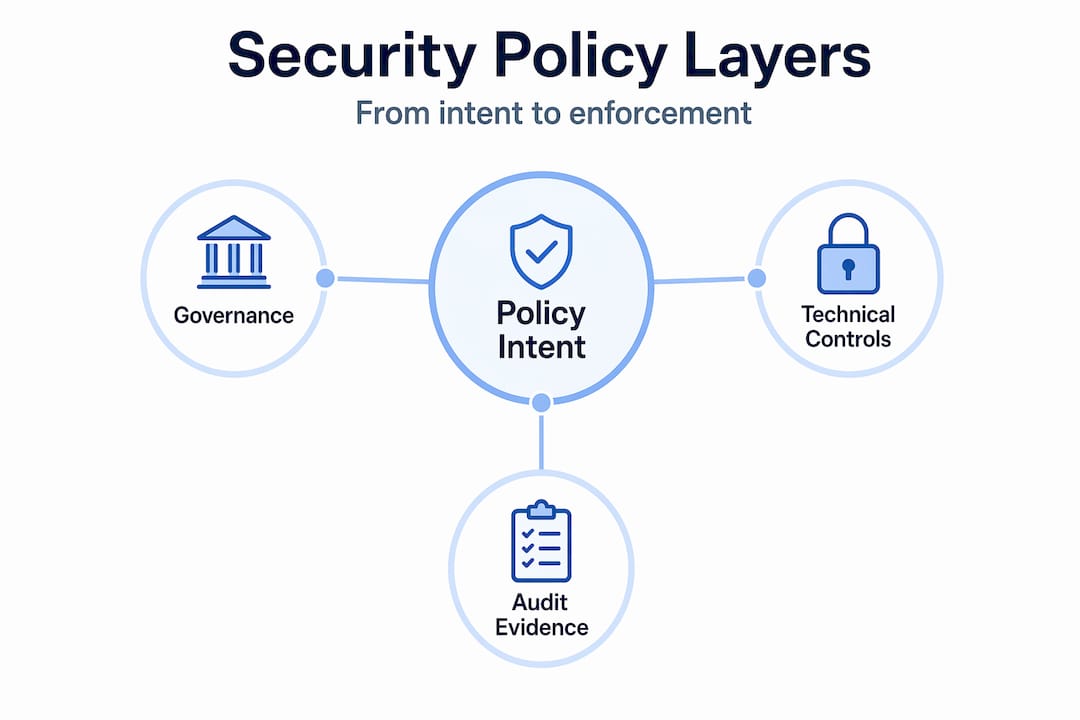
The importance of security policies becomes most visible when you look at governance requirements. Under ISO/IEC 27001:2022, for example, top management must establish an authorized, version-controlled Information Security Policy communicated broadly enough to ensure employee awareness. This is not optional ceremony — auditors will check for authorization signatures, version histories, and evidence that staff have actually seen and understood the policy.
A well-structured security policy should address the following areas:
- Compliance obligations. Legal, regulatory, and contractual requirements relevant to your sector.
- Risk management directives. Guidance on how the organization identifies and treats information security risks.
- Roles and responsibilities. Who owns security decisions, who enforces controls, and who reports incidents.
- Objectives. Measurable security goals that management has approved and committed to achieving.
- Scope. Which systems, people, locations, and data the policy covers.
This foundation also intersects with enterprise IT solutions security examples, where governance structures are typically aligned with both regulatory requirements and operational realities. Organizations that treat policy development as a governance discipline — rather than a paperwork exercise — build a measurably stronger security posture.
Transforming security policies into living governance mechanisms
Having established the foundation, let’s examine how policies evolve into active governance tools.
One of the clearest indicators of a mature security program is whether policies are reviewed and updated on a defined schedule. Security policies should be reviewed annually and updated when changes in threats, technology, or organizational mission occur, then effectively communicated and enforced across the organization — a standard reinforced by CISA’s Cybersecurity Performance Goals. That cycle is not a bureaucratic formality. A policy written before your organization migrated to a cloud-first architecture, for instance, may not address identity federation, shared responsibility models, or API security at all.
Transforming policies into living governance mechanisms requires a deliberate, phased approach:
- Assign policy ownership. Every policy needs a named owner accountable for accuracy, updates, and enforcement. Without ownership, reviews slip.
- Define a review trigger list. Annual reviews are the floor, not the ceiling. Triggers should include new regulations, major system changes, significant incidents, and shifts in threat intelligence.
- Map policies to operational controls. Each policy statement should link to specific technical or administrative controls. Vague policy language that cannot be tested against a system state provides no real protection.
- Establish communication channels. Email blasts are not enough. Use onboarding workflows, intranet portals, training platforms, and manager-level briefings to ensure reach.
- Measure enforcement. Track metrics such as configuration drift rates, exception request volumes, and audit findings that trace back to policy gaps.
“A security policy that employees cannot find, do not understand, or have never been told about is not a policy — it is a liability.”
Pro Tip: When updating policies after a threat landscape change, include a brief change summary at the top of the document explaining what changed and why. This helps employees understand the practical relevance and increases the likelihood they will absorb the update.
The broader security policy governance examples across industries show that organizations with documented governance cycles consistently perform better in audits and respond faster to incidents than those without.
Linking policies to technical enforcement: Configuration checklists and identity-token management
Understanding governance, now explore how policies connect to technical enforcement and controls.
A policy that says “systems must be securely configured” means nothing unless it connects to a specific, testable standard. This is where security configuration checklists become essential — NIST SP 800-70 Rev. 5 establishes that these checklists help configure, verify, and detect unauthorized changes to IT products, making policy enforcement auditable and reducing the attack surface created by default or misconfigured settings.
Configuration checklists serve multiple functions in a policy-driven security program:
- They translate abstract policy requirements into specific, measurable system states.
- They provide a baseline against which configuration drift can be detected automatically.
- They create audit evidence that policy requirements were implemented and verified.
- They reduce reliance on individual administrator judgment, which varies and can create inconsistency.
Identity and access management presents a similarly concrete enforcement opportunity. Token management policies must define requirements for token lifetimes, validation procedures, key management, auditing, and incident response — and enforcement must happen at the application level, where tokens are verified dynamically before access is granted. NIST IR 8587 makes clear that policies in this domain are only effective when applications are configured to reject invalid or expired tokens in real time, not just in theory.
| Policy area | Technical enforcement mechanism | Audit evidence produced |
|---|---|---|
| System configuration | Security configuration checklists | Baseline comparison reports |
| Identity and access | Token validation at application layer | Access logs and token audit trails |
| Patch management | Automated patch deployment tools | Patch status dashboards |
| Incident response | Defined escalation workflows | Incident tickets and response timelines |
Pro Tip: Align your configuration checklists with CIS Benchmarks or DISA STIGs where applicable. These are pre-built, widely accepted standards that map to common policy requirements and save significant development time.
Connecting technical policy enforcement examples to your governance documentation creates a traceable chain from policy intent to system state, which is exactly what auditors and regulators look for.
Navigating complex frameworks: How NIST SP 800-53 and RMF shape policy effectiveness
With technical enforcement clear, let’s examine how comprehensive control frameworks ensure policy effectiveness.
The benefits of having security policies become fully realized only when those policies are tied to a rigorous control framework. NIST SP 800-53 catalogs over 1,000 security and privacy controls, and the Risk Management Framework (RMF) governs how those controls are selected, implemented, assessed, authorized, and continuously monitored. Together, they form the backbone of security policy effectiveness for federal agencies and increasingly for regulated private sector organizations.
RMF operates through a defined sequence of steps that transforms policy requirements into operational security:
| RMF step | Activity | Policy connection |
|---|---|---|
| Categorize | Determine system impact levels | Policy scope and risk tolerance |
| Select | Choose appropriate controls | Policy-to-control mapping |
| Implement | Deploy controls in systems | Technical enforcement |
| Assess | Test control effectiveness | Policy compliance verification |
| Authorize | Management decision on risk | Leadership accountability |
| Monitor | Ongoing tracking of control state | Continuous policy enforcement |
Key benefits that this framework delivers include:
- Tailored control selection. Controls are chosen based on the organization’s mission, data sensitivity, and risk impact levels, not applied uniformly regardless of context.
- Formalized authorization. No system goes into production without management formally accepting residual risk, which ties executive accountability directly to policy decisions.
- Continuous monitoring. Rather than point-in-time assessments, NIST policy control examples show that ongoing monitoring keeps the security posture aligned with policy requirements as environments change.
Security policy effectiveness, in the NIST model, is not assumed after implementation. It is verified through structured assessment and maintained through monitoring. That distinction is critical for IT leaders building programs designed to hold up under regulatory scrutiny.
Implementing and maintaining effective security policies: Practical steps for IT leaders
Now that we understand frameworks, let’s explore practical implementation advice to turn policy into effective practice.

Security policy implementation is where many organizations lose momentum. The gap between a well-written policy document and actual organizational behavior is wider than most leaders expect. Closing that gap requires deliberate process design.
Follow this sequence for initial policy deployment:
- Draft with organizational context. Policies written without reference to your specific technology environment, risk profile, and regulatory obligations will not resonate with the people who need to follow them.
- Obtain management authorization. Document approval with signatures, version numbers, and effective dates. This is not optional for ISO 27001 or SOC 2 compliance.
- Build a communication plan. Identify every audience the policy affects, the channel best suited to reach them, and the verification method you will use to confirm receipt and understanding.
- Set a mandatory review date. Embed the review date into the policy document itself, and schedule it in a governance calendar owned by a named individual.
- Link to technical controls. Every policy statement should map to at least one technical or procedural control. If it cannot, reconsider whether the statement belongs in the policy.
- Retain audit evidence. ISO 27001 audits seek evidence of policy communication and staff understanding, including onboarding attestations and training logs, not just the policy document itself. Build this evidence generation into your standard processes.
Additional operational considerations for ongoing maintenance:
- Run tabletop exercises that reference specific policy requirements to test whether teams understand and can act on them.
- Use automated monitoring tools to generate alerts when system states drift from policy-defined baselines.
- Track exception requests and waivers as a leading indicator of policies that may need revision.
- Conduct post-incident reviews that explicitly identify whether a policy gap contributed to the event.
Pro Tip: Create a one-page policy summary for each major audience group. A developer-facing version of your access control policy will be more effective than expecting all employees to parse a 20-page governance document.
The security policy implementation tips that consistently yield the best audit outcomes share one trait: they treat evidence generation as a designed process, not an afterthought.
Why treating security policies as living enforcement tools is the key to resilience
With implementation tips shared, consider this fresh viewpoint challenging conventional policy practices.
After more than 25 years working with organizations across healthcare, transportation, and research sectors, we at Supra ITS have observed a consistent pattern: the organizations that suffer the most significant security failures are rarely the ones without any policies. They are the ones with policies that stopped evolving.
Policies treated as guidelines rather than enforceable controls fail to impact actual system behavior, leaving gaps in authentication, authorization, and configuration enforcement that attackers exploit with predictable regularity. The uncomfortable truth is that a static policy document can create a false sense of compliance. Leadership signs off, the document is filed, and everyone assumes the risk has been addressed. But if no system has been reconfigured, no identity control has been updated, and no employee has changed a behavior, the policy has done nothing.
The shift we advocate is treating policy enforcement insights as operational data. Every configuration drift alert, every failed token validation, every access request that falls outside policy scope is a signal about the gap between your documented intent and your actual security state. Organizations that feed those signals back into the policy review process continuously narrow that gap. Those that do not accumulate technical debt in their security programs the same way they accumulate it in their codebases.
Leadership accountability is the variable most often overlooked. Policies reviewed and signed by executives who do not understand what they are authorizing tend to drift toward irrelevance. When senior leaders are briefed on specific threat scenarios tied to policy gaps, the review process gains urgency and precision that produces meaningfully better outcomes.
Enhance your organization’s security posture with SupraITS solutions
To successfully implement these strategic and technical insights, consider partnering with industry experts to optimize your policies and defenses.
Translating policy frameworks into measurable, auditable security controls requires more than good documentation — it requires technical depth, regulatory knowledge, and the operational capacity to maintain enforcement continuously. Supra ITS brings over 25 years of experience and a team of 650+ specialists who understand how to align governance requirements with real-world technical environments.

Our SOC 2 Type II certified IT solutions cover the full spectrum of what effective security policy implementation demands: configuration management, identity and access controls, continuous monitoring, and compliance readiness across healthcare, transportation, and research sectors. Whether you are building your first formal policy framework or working to close gaps identified in a recent audit, we provide the expert guidance and tools to keep your policies current, enforced, and defensible. Contact Supra ITS to learn how we can support your program.
Frequently asked questions
What is the central role of security policies in an organization?
Security policies establish high-level directives that guide cybersecurity practices, ensuring compliance, risk management, and protection against evolving threats. Per CISA CPG 2.0, they must function as living governance mechanisms reviewed and adapted continuously, not static reference documents.
How often should security policies be reviewed and updated?
Policies should be reviewed at least annually and updated whenever significant changes in threats, technology, or organizational mission occur. CISA CPG 2.0 treats this cadence as a baseline requirement, not a best practice suggestion.
What evidence do auditors look for to verify policy effectiveness?
Auditors expect proof of communication and staff awareness, not just the policy document. ISO 27001 Clause 5.2 specifically requires evidence that employees have been informed and understand the information security policy, such as signed acknowledgments and training completion records.
How do security policies relate to technical enforcement controls?
Policies define requirements that must translate directly into technical controls, including configuration checklists and identity-token validation at the application layer. NIST SP 800-70 links configuration policy directly to auditable enforcement mechanisms that detect unauthorized system changes.
Can security policies alone guarantee organizational security?
No. Policies must be implemented, assessed, and continuously monitored alongside technical controls to reduce risk effectively. NIST SP 800-53 and RMF establish that policy effectiveness depends on structured assessment, formal authorization, and ongoing monitoring — not on the existence of the policy document alone.
Recommended


